The AI Regulation Map: What Every State and the Feds Are Actually Doing
If you’ve been following AI regulation through headlines, you’ve probably gotten the impression that nothing is happening, or that everything is happening, or that everything is about to be undone. All three are partially true. The reality is messier and more interesting than any single headline can carry.
Here is what is actually true in April 2026.
The Short Version
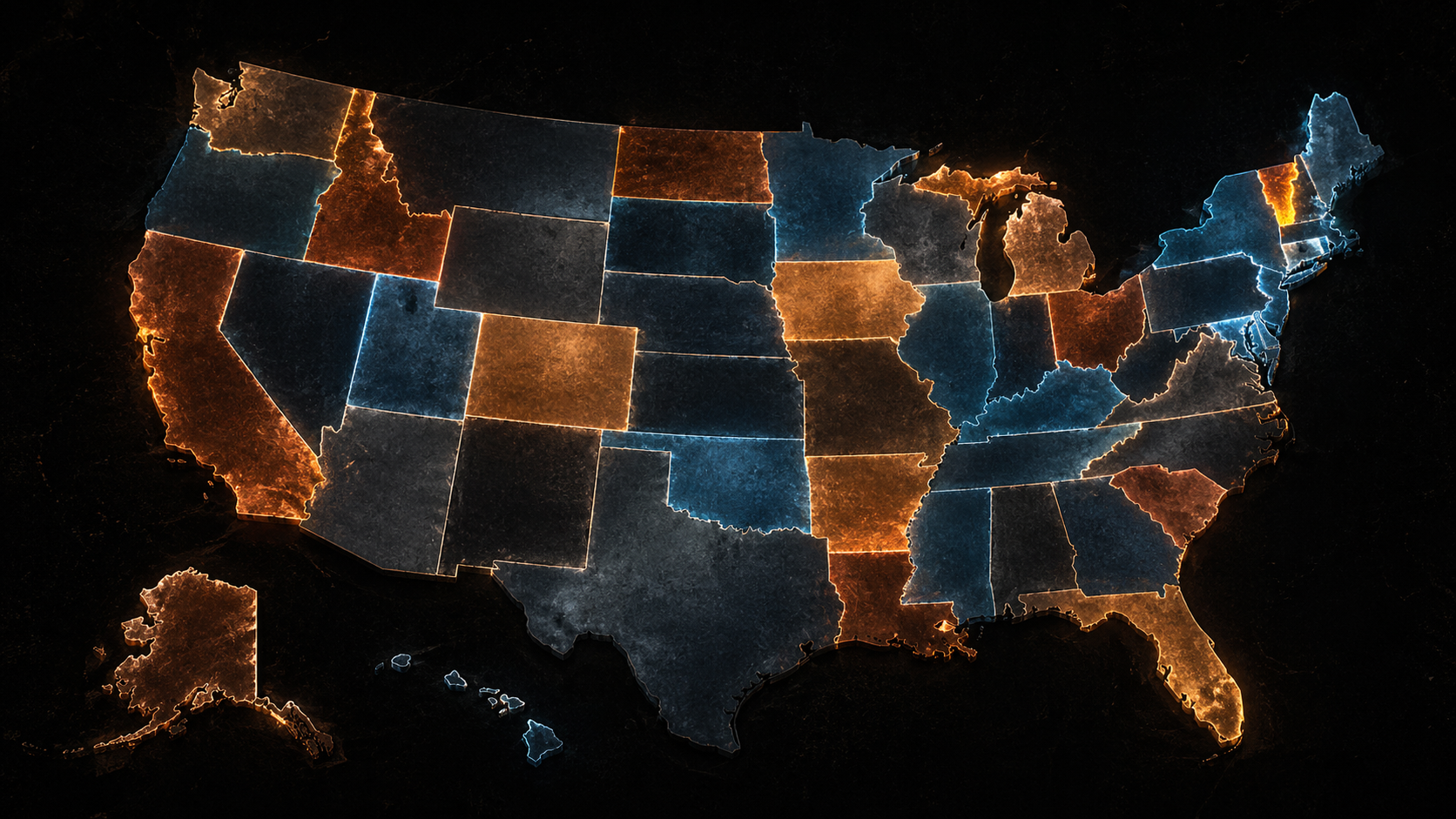
States moved first. Three dozen of them passed AI laws in 2025. A handful of those laws — California, Colorado, New York, Texas — are detailed enough to actually constrain how big AI companies do business. The federal government, under the second Trump administration, wants to undo all of that and replace it with a single light-touch federal framework that would override state rules. The states aren’t going quietly. Congress, surprisingly, isn’t either.
This is the fight, in one sentence: whoever sets the precedent that gets adopted nationally wins how AI is governed in this country for the next decade.
What the States Actually Did
Three state laws are the ones that matter most because they’re the most demanding, they apply to the biggest companies, and they’re already in effect or close to it.
California’s Transparency in Frontier Artificial Intelligence Act (TFAIA) went into effect January 1, 2026. It targets “frontier developers” — the small set of companies training models above 10^26 floating-point operations. Big developers with combined annual revenue over $500 million face additional transparency requirements. The law is built around reporting and disclosure rather than direct prohibition.
New York’s Responsible AI Safety and Education Act (RAISE Act) was signed by Governor Hochul on December 19, 2025, and amended on March 27, 2026. It now resembles California’s framework but with sharper teeth on incident reporting — RAISE requires disclosure within 72 hours of a serious incident, where TFAIA gives 15 days.
Colorado’s SB 24-205 is the broadest. It treats AI used in “high-risk” decisions — hiring, housing, lending, healthcare — as a regulated category, requires impact assessments, and creates a duty of reasonable care for both developers and deployers. The law was originally going to take effect February 1, 2026. After intense industry pushback during a special session, the legislature delayed it to June 30, 2026. Notably, despite over a hundred and fifty industry lobbyists working that special session, all of the core provisions survived. The delay bought time. It didn’t change the rules.
What Trump Did
On December 11, 2025, the White House issued an executive order titled “Ensuring a National Policy Framework for Artificial Intelligence.” The order does two things. First, it directs the Attorney General to set up an AI litigation task force whose job is to challenge state AI laws on the grounds of unconstitutional regulation of interstate commerce and federal preemption. Second, it lays the groundwork for a unified federal AI policy that would supersede state laws the administration considers inconsistent.
In March 2026, the Commerce Department published an evaluation that explicitly flagged laws in California, Colorado, and New York for additional scrutiny. On March 20, 2026, the White House released its full legislative framework, formally asking Congress to pass a federal AI law that would broadly preempt state laws deemed to impose “undue burdens.”
The legal theory is clean enough on paper. Interstate commerce is a federal matter. AI services cross state lines by definition. A patchwork of fifty different state AI laws creates a compliance nightmare and an effective tax on innovation. So the federal government should set one standard, and that standard should be the floor and the ceiling.
The political reality is messier. Earlier in 2025, Congress had a chance to attach a federal preemption provision to a major piece of AI legislation. The Senate voted 99-1 to strip it out. The only senator who wanted to keep it was Thom Tillis of North Carolina. The bill was signed into law on July 4, 2025, with no federal preemption of state AI rules.
That vote tells you most of what you need to know about how this fight goes from here. Federal preemption of state AI law is not a Republican-vs-Democrat issue. It’s a federal-vs-state issue. And state legislators of both parties are protective of their authority.
The State Pushback
In December 2025, two hundred and eighty state lawmakers from across the country signed a joint letter opposing federal preemption of state AI laws. The signatories were Republicans and Democrats. The argument was simple: states want to keep their ability to write their own AI rules, and they aren’t willing to trade that for federal protection.
In California specifically, Governor Newsom issued an executive order on March 30, 2026, directing state agencies to make their own determinations about whether to do business with AI companies that the federal government has flagged. That order was the first serious institutional rejection of the federal preemption push. (We wrote about the company that triggered it, Anthropic, here.)
What this all looks like in aggregate: a federal administration trying to consolidate regulatory authority, and a coalition of states — large, small, red, and blue — refusing to give it up.
The EU, for Context
The EU AI Act entered force in August 2024. Its first set of major requirements were supposed to start hitting in 2026. By early 2026, the European Commission was openly considering pushing some of those deadlines back to 2027 or 2028, citing implementation difficulty and pressure from industry.
This matters for the U.S. fight because the EU was supposed to be the example of “what happens if you regulate AI too aggressively.” If the EU walks its own deadlines back, that argument loses some of its force. If the EU holds the line, U.S. federal officials will use the EU experience as evidence that prescriptive regulation strangles innovation. Either way, the EU is no longer the lead actor in this story. The U.S. states are.

What This Actually Means for You
If you’re a small developer or a hobbyist running local models, none of these laws apply to you. The thresholds — frontier model training, $500 million in revenue, high-risk decision systems at scale — are designed to catch the biggest companies, not the people building things at home. That is intentional.
If you’re at a company doing anything that touches AI at scale, the picture is genuinely complicated. You probably need to comply with California TFAIA today, with New York RAISE in some form, and with Colorado in June if it survives. You probably also need to plan for the federal framework that’s almost certainly coming, because even though Congress voted down preemption once, the executive order strategy and the litigation task force change the dynamics.
If you’re a citizen who wants to understand whether AI is being meaningfully regulated, the honest answer is: yes, in some places, by some people, with mechanisms that are at least serious enough to make the largest companies invest heavily in lobbying against them. Whether the system that emerges from the next two years is closer to California’s transparency-and-disclosure model or to the federal government’s “trust us, we’ll handle it” model is what’s actually being decided right now.
What to Watch
A few specific dates and decisions over the next year will tell you which direction this is going.
June 30, 2026 — Colorado’s SB 24-205 either takes effect or gets delayed again. If it takes effect, expect lawsuits within weeks. If the legislature delays it again, that will be read as a signal that pure compliance pressure can move state legislatures.
The first federal preemption lawsuit — the AG’s litigation task force will eventually file its first challenge to a state AI law. The plaintiff and the state will tell you which precedent the administration thinks it can win on.
The midterm elections — AI regulation is on the ballot in several states, and AI industry money is flowing in both directions. Whoever wins state legislatures in 2026 will set the next round of rules for 2027 and beyond.
Federal legislation — if Congress actually passes something resembling the White House’s March 2026 framework, the entire state-level effort gets pulled into federal court for years of preemption litigation. If Congress does nothing, the states keep moving and the executive order strategy is all the federal government has.
The smart bet today is that the picture stays fragmented. State laws hold. Federal preemption gets attempted, partially succeeds in court, partially fails, and we end up with something like the privacy regulation regime — federal floor in some areas, stricter state rules in others, and an enormous amount of money spent on compliance lawyers.
That’s not chaos. It’s how American regulation usually works.
We’ll keep updating this picture as the dates roll over. The next big inflection point is June 30. Mark it.